A practical procurement guide for port, container terminal, railway station and airport owners who need high mast lighting with field-control redundancy, local fallback, alarm records, energy evidence and owner-reviewable handover files.
In a port, container terminal, railway station or airport apron, high mast lighting is not only a luminaire purchase. It is a field-control system working inside metal reflection, moving obstruction, salt fog, long cable routes, night maintenance pressure and strict safety zones.
For airport aprons, aircraft hangars, port terminals and national strategic infrastructure, the lighting question is not only pole height or wattage. The owner needs a recoverable control system that can keep field zones visible, traceable and locally manageable under strict communication rules, moving metal obstruction and high-security operating procedures.
Aircraft hangars create a dense metal environment with large doors, high roofs, maintenance platforms, aircraft bodies, service vehicles and restricted working windows. High mast and high-bay lighting control should therefore be reviewed through zone identity, gateway records, local fallback, alarm traceability and maintenance closure, not only luminaire output.
Some strategic infrastructure projects cannot be disclosed by project name because of confidentiality agreements. The transferable evidence is the engineering method: CH-800 Gateway zones, HYBRID PLC & LoRA field communication, offline fallback behavior, FAT/SAT records, configuration backup and owner-held operation evidence.
For high mast lighting in ports, container terminals, railway stations and airports, wattage alone does not define system performance. A complete review should explain the field conditions, communication routes, FAT/SAT evidence and the owner's ability to operate and maintain the system after handover.
Core answer: complex high mast lighting environments should use HYBRID PLC & LoRA dual-channel field communication. PLC protects feeder-based field control; LoRA adds wireless route redundancy across wide yards and metal-heavy zones. CAT-1, Ethernet or fiber can be added for backhaul, control-room access or owner-network integration, but they should not replace field-level redundancy.
The owner should see the core answer before reading long text: this is not a decorative lighting page. It is a communication, safety, maintenance and handover evidence page for large-area infrastructure lighting.
Use this page if your team is comparing smart high mast lighting, port high mast lighting, container terminal lighting, railway station lighting, airport apron lighting or large-yard LED lighting control.
High mast lighting projects often begin with pole height, lumens, wattage and uniformity. These parameters are necessary, but they do not answer the most expensive after-sales question: when a large yard zone does not respond at night, can the owner quickly know whether the issue comes from a lamp, feeder circuit, controller, gateway, communication route, operator action or configuration file?
Ports, terminals, railway stations and airports are not normal outdoor lighting sites. They contain tall steel structures, moving machinery, container stacks, long cable runs, salt fog, security-controlled networks and strict maintenance windows. A high mast lighting proposal should therefore be reviewed as an infrastructure control system.
In a tunnel or pipe gallery, lighting must support inspection, emergency response, local fallback and owner handover. High mast lighting in ports and transport hubs has the same hidden requirement: it must keep field zones controllable under complex, harsh and security-sensitive communication conditions.
| Site Condition | Lighting Requirement | Evidence the Owner Should Request |
|---|---|---|
| Coastal port | Stable lighting near seawater, berths, service roads and cargo handling zones. | Salt-fog protection, cabinet sealing, pole-group identity, PLC route test and LoRA coverage record. |
| Container terminal | Wide-yard visibility under moving cranes, stacked containers and changing metal obstruction. | Dual-channel communication test, crane-side response, container-stack shadow check and night command record. |
| Railway station / rail yard | Public safety, platform visibility, track-zone segmentation and short maintenance windows. | Zone map, emergency scene, manual override, feeder segmentation and SAT response record. |
| Airport apron | Controlled brightness, service-vehicle routes, glare discipline and strict maintenance timing. | Scene schedule, glare-zone control, alarm history, local fallback and maintenance closure file. |
| Network interruption | Field rules continue without waiting for cloud, SIM card or WAN recovery. | CH-800 Gateway offline test, local schedule storage and post-recovery event record. |
A single communication method is fragile in metal-heavy, wide-area and security-managed sites. PLC uses the power-line route to protect feeder-based control. LoRA provides wireless route redundancy across large yards where cable modification is expensive or physical obstruction changes. Together they give the owner a stronger field-control baseline.
| Layer | What It Should Do | Acceptance Check |
|---|---|---|
| PLC field channel | Support feeder and pole-group command delivery through real power-line routes. | Test line quality, circuit segmentation, response time and command feedback. |
| LoRA field channel | Support wide-area wireless control when metal obstruction or distance challenges a single route. | Test antenna position, blocked-zone response, moving-obstruction behavior and recovery. |
| CH-800 Gateway | Store scene rules, collect field status, organize zones and support local fallback. | Verify gateway-zone map, offline behavior, alarm record and command history. |
| CAT-1 / Ethernet / Fiber | Provide remote monitoring, control-room connection or owner-network integration. | Confirm this is backhaul access while PLC & LoRA protect field control. |
For complex high mast lighting sites, the communication decision should not be reduced to a single technology label. PLC and LoRA each have strong advantages, but each also has a clear weakness when used alone. The updated engineering answer, based on the older PLC / LoRA / GPRS / 485 / DALI / ZigBee / WiFi comparison logic, is to use HYBRID PLC & LoRA as the field-control baseline and use CAT-1, Ethernet or fiber only as the backhaul or control-room access layer.
| Communication Route | Main Advantage | Main Weakness | Updated Engineering Notes | Buyer Conclusion |
|---|---|---|---|---|
| HYBRID PLC & LoRA | Two field-control paths: PLC follows the power feeder route while LoRA adds wireless redundancy across wide or metal-heavy zones. No extra signal cable is required for the field layer. | Requires professional commissioning: feeder mapping, gateway zoning, LoRA coverage tests, pole identity and controller address files must be organized carefully. | PLC supports structured electrical routes, while LoRA provides an additional path across wide yards and obstruction-prone zones. The combined architecture reduces dependence on a single communication route. | Recommended for evaluation where lighting cannot depend on one communication path and the owner requires recoverable operation after handover. |
| PLC Only | Uses existing power lines, avoids extra wireless coverage planning, has low supporting-material cost, and is effective for cabinet, feeder and pole-group control when line quality is suitable. | Performance depends on feeder quality, electrical noise, distance, phase or circuit segmentation and wiring topology. Modern OFDM PLC improves resilience but still follows the actual power-line path. | Suitable for tunnels, pipe galleries, road cabinets and controlled feeder routes. Wide yards with mixed feeders or uncertain electrical routes may benefit from LoRA redundancy. | Suitable for structured electrical routes; additional redundancy should be assessed for complex high mast environments. |
| LoRA Only | Long-range wireless coverage, flexible deployment, no signal wiring, a short installation period and useful coverage across large outdoor yards or old-city retrofit streets. | Performance can be affected by antenna position, metal shielding, container stacks, cranes, trains, terrain, cabinet placement and local interference. | Suitable as a wide-area field route, as a second route for PLC-based systems, or for old urban retrofit areas where power-line quality is poor. | Well suited to retrofit and irregular power-line environments; combined PLC redundancy can be evaluated for critical ports and transport hubs. |
| CAT-1 / Ethernet / Fiber Only | Useful for backhaul, remote monitoring, control-room connection, private network access and data upload. Fiber or Ethernet can support isolated owner networks. | Does not automatically solve field-level lamp, feeder and pole-group control. SIM, WAN, server or network policy problems may still affect remote access. | This is the modern replacement for the older GPRS / Internet layer in the 2020 comparison. It should connect the platform and gateway, while PLC + LoRA protect the field-control layer. | Important as an access layer, but it should not replace PLC + LoRA field-level redundancy in complex communication environments. |
| Communication Channel | Typical Limitation for High Mast Applications | Recommended Engineering Role |
|---|---|---|
| GPRS | Older mobile data route. It depended on operator signal and was expensive for large device counts. It should no longer be described as the main modern solution. | Update to CAT-1 / NB-IoT / 4G / Ethernet / fiber backhaul, depending on project policy and owner network. |
| RS485 / CAN / RS232 | Strong for short-distance industrial control or device-to-device communication, but wiring and distance limits make them unsuitable as the main route for large outdoor high mast projects. | Use only inside cabinets, local devices or limited industrial interfaces, not as the main yard communication architecture. |
| DALI | Useful for indoor or building lighting control, while wiring distance, outdoor protection and maintenance requirements may limit its role in ports, terminals and high mast yards. | Typically used for local lighting interfaces rather than as the primary long-distance field communication route. |
| ZigBee / WiFi | Low-cost and familiar, while metal shielding, distance, security, outdoor reliability and device-count management require careful review in industrial yards. | Generally better suited to local-area functions than to the primary field route for ports, railways, airports or high mast infrastructure lighting. |
LoRA should not be described only as a backup channel. In old urban renovation projects, LoRA can be the more practical main field route because the power-line environment may be too chaotic for stable PLC communication.
Many old-city street lighting systems have served for 20-30 years or even longer. Some lamps are supplied from the main street-lighting transformer, while other lamps may be connected through residential power, community distribution lines or mixed historical wiring. On the same pole, there may be 30-50 different cables, including power lines, telecom lines, network cables, legacy control wires and 5-10 different operator routes.
A single-channel design may still work for simple roads, small parks or controlled feeder routes. For high mast lighting in ports, terminals, railway stations and airports, the owner should require additional redundancy or documented mitigation when the site has obvious obstruction, high maintenance cost or strict operational responsibility.
| Project Condition | Why Single PLC Is Risky | Why Single LoRA Is Risky | Correct Procurement Question |
|---|---|---|---|
| Large metal structures | PLC may still work through feeders, but it cannot solve every wrong circuit, bad wiring or long-distance segmentation problem alone. | Wireless signal can be blocked or reflected by cranes, containers, steel roofs and service vehicles. | Can the supplier prove both PLC route and LoRA coverage under real yard conditions? |
| High pole access cost | If PLC feedback is unclear, the team may still need expensive high-access inspection. | If a wireless blind zone appears, the team may not know whether the lamp, controller or signal route failed. | Can the platform narrow the fault before lift equipment, boom trucks or night closure are arranged? |
| Security-managed network | PLC alone does not define how the gateway reports to the owner network or stores records locally. | LoRA alone does not solve backhaul, account authority, data export or control-room integration. | Can field control continue locally while CAT-1 / Ethernet / fiber access is interrupted or restricted? |
| Multi-party handover | Electrical route, cabinet record and controller identity may not be enough for future maintenance teams. | Wireless address and coverage records may not be enough to explain circuit responsibility. | Does the final SAT file connect pole, feeder, controller, gateway, alarm and maintenance owner? |
High mast lighting buyers often face a mixed procurement problem: the lighting designer wants lux level, the operations team wants night safety, the electrical contractor wants simple wiring, the maintenance team wants fault location, and the owner wants a system that remains understandable after handover.
| Operational Concern | Typical Project Risk | STSYSTEMPLC Engineering Response |
|---|---|---|
| Only fixture parameters are compared | The project may meet fixture specifications while leaving control performance undocumented after installation. | STSYSTEMPLC connects luminaires, controllers, CH-800 Gateway zones, PLC + LoRA communication and owner-held records. |
| Metal-heavy field blocks communication | Containers, cranes, trains or airport service vehicles create unstable response. | HYBRID PLC & LoRA gives two field-control routes instead of relying on one path. |
| Network policy is strict | Cloud, SIM card or public network access may be restricted by the owner. | The gateway supports local schedules and approved lighting behavior when external connection is unavailable. |
| Fault responsibility is unclear | After handover, teams cannot tell whether failure came from lamp, circuit, controller or communication. | Alarm history, pole identity, gateway logs and maintenance closure records are included in acceptance logic. |
| Maintenance requires costly access | High poles, large yards and night operations make troubleshooting expensive. | Remote diagnosis and zone evidence reduce blind inspection before lift equipment or pole access is arranged. |
FAT/SAT should not be a loose checklist. Each row should connect a real operating scene with field response, communication route and owner evidence. The table below is designed for port, terminal, railway station and airport high mast projects.
| Acceptance Item | FAT Review Before Delivery | SAT Review On Site | Owner-Held Evidence |
|---|---|---|---|
| Lighting output | Power, CCT, driver setting, dimming curve and fixture label verification. | Lux level, uniformity, aiming angle and night-scene confirmation. | Photometric record, zone acceptance form and final fixture list. |
| PLC field route | Controller addressing, feeder route logic and command simulation. | Real circuit response, line quality and pole-group feedback. | PLC route test, circuit map and exception list. |
| LoRA field route | Gateway pairing, antenna plan and wireless command simulation. | Coverage test under real yard obstruction and long-distance response. | LoRA coverage record, weak-zone list and correction action. |
| Offline autonomy | Local schedule and fallback scene simulation. | External network interruption test with lighting still operating. | Offline operation record and recovery record. |
| Alarm evidence | Fault simulation for lamp, circuit and communication exceptions. | Actual alarm routing, maintenance ticket and recovery confirmation. | Alarm history, maintenance action and responsible zone. |
| Asset identity | Pole code, controller code, cabinet code and gateway zone mapping. | Field asset and platform record match. | Asset list usable for future maintenance. |
High mast lighting belongs to infrastructure engineering when it is used in ports, terminals, railway stations and airports. Long-corridor roadway, bridge and tunnel experience helps owners review whether a supplier understands recoverable operation, staged commissioning, field records and multi-party acceptance.
Buyers comparing global lighting brands, local pole suppliers, electrical contractors and smart lighting platforms should compare the complete control and evidence chain, not only luminaire efficiency or pole price.
| Supplier Route | Typical Strength | Risk to Check | STSYSTEMPLC Project Focus |
|---|---|---|---|
| Global lighting brand | Optics, fixture design and international references. | Whether the field-control layer and owner records are project-specific enough. | Integrate luminaires with CH-800 Gateway, HYBRID PLC & LoRA, alarm records and FAT/SAT files. |
| Local pole / EPC supplier | Fast construction coordination and civil-work experience. | Whether communication, gateway logic and software records are mature. | Provide lighting-specific control architecture and acceptance evidence beyond installation. |
| General-purpose IoT platform | Dashboard, device connection and remote monitoring. | How field lighting continues to operate in metal-heavy environments. | Keep field operation local-first with dual-channel communication and gateway fallback. |
| Fixture-only supplier | Low initial price and simple procurement. | No owner evidence when communication, alarm or maintenance responsibility becomes unclear. | Provide system-level continuity from lamp controller to gateway, records and handover files. |
Port High Mast Lighting System
Focus: coastal salt fog, berth roads, sealed cabinets, PLC route test and LoRA coverage.
Container Terminal High Mast Lighting
Focus: cranes, moving metal blocks, container stacks, dual-channel command response and yard-zone dimming.
Railway Station High Mast Lighting
Focus: platforms, track yards, public safety, maintenance windows and fast fault location.
Airport Apron High Mast Lighting
Focus: glare discipline, security network, service vehicle routes, alarm evidence and local fallback.
High mast lighting looks similar from a distance, but the control risk changes by site. A port cares about salt fog and berth operation. A container terminal cares about moving metal blocks and crane shadow. A railway station cares about public safety and track-zone maintenance. An airport apron cares about glare, security and strict maintenance timing. The shared rule is the same: the field layer should use HYBRID PLC & LoRA, while the acceptance documents should be written around the real operating scene.
| Site Type | What Usually Goes Wrong | Dual-Channel Design Focus | Owner Review Standard |
|---|---|---|---|
| Seaside port | Salt fog, wet cabinets, corroded terminals, long cable runs and delayed night repair. | PLC route through cabinet and feeder logic; LoRA route for berth-side redundancy and wide-area control. | Cabinet protection, terminal aging plan, feeder map, LoRA coverage, alarm source and maintenance closure. |
| Container terminal | Containers move every day, cranes block radio paths, and yard zones change with operation. | PLC protects stable feeder groups; LoRA reduces blind spots created by moving metal stacks. | Night response test under real container layout, crane-side command record and weak-zone correction list. |
| Railway station / rail yard | Long platforms, track zones, public areas and maintenance roads require different scenes. | PLC for circuit and platform segmentation; LoRA for long-yard coverage and maintenance route support. | Passenger-area scene, track-yard scene, maintenance override, emergency route and post-fault recovery file. |
| Airport apron | Glare discipline, security isolation, aircraft service routes and planned maintenance windows are strict. | PLC protects local electrical control; LoRA adds command redundancy where wired changes are costly. | Apron-zone scene, glare-sensitive area, service-vehicle route, alarm record and approved fallback behavior. |
A complete high mast lighting proposal should describe system behaviour when communication is interrupted or degraded. Reviewing failure modes before contract award allows the owner to verify diagnosis, fallback and recovery procedures in advance.
| Failure Mode | Typical Cause | Limited Diagnostic Response | STSYSTEMPLC Verification Requirement |
|---|---|---|---|
| Partial zone does not respond | Feeder issue, wrong address, blocked wireless route or gateway grouping error. | Operator only sees an offline icon and must send people to inspect blindly. | PLC route feedback, LoRA backup path, gateway zone record and exact pole-group identity. |
| Network is unavailable | SIM card issue, WAN interruption, control-room network isolation or security restriction. | The field lighting waits for cloud recovery or loses scheduled behavior. | CH-800 local schedule, approved fallback scene, offline alarm storage and recovery history. |
| Metal obstruction changes | Container stack height, crane movement, train position or service vehicle parking. | Wireless-only response may become less predictable as obstruction conditions change. | HYBRID PLC & LoRA route design, field coverage test and obstruction-condition SAT record. |
| Maintenance team changes | Contractor handover, staff turnover or poor document transfer. | New team cannot match platform records with real poles, cabinets and circuits. | Asset map, controller code, gateway zone, cabinet drawing, FAT/SAT file and backup configuration. |
| Energy-saving claim is challenged | No baseline, incomplete records or unclear scene schedule. | Energy saving becomes a sales statement instead of owner-verifiable evidence. | Scene schedule, dimming history, energy record and operation log connected to actual zones. |
High mast lighting projects should not be accepted only for the first night. Ports, terminals, railway stations and airports need maintenance logic that still makes sense after year 5, year 8 and year 10.
Many high mast lighting disputes happen because responsibility is not mapped clearly. The owner needs evidence; the EPC needs installation boundaries; the lighting supplier needs controller and fixture records; the maintenance team needs actionable fault information. A complete proposal should make these responsibilities visible.
| Role | What They Need | Risk If Missing | Document to Keep After Handover |
|---|---|---|---|
| Owner / operator | Safe lighting scenes, energy records, alarms, account authority and reviewable evidence. | Cannot judge whether the system is saving energy or simply reducing visibility. | Owner account, scene schedule, energy baseline, alarm report and acceptance archive. |
| EPC contractor | Clear cabinet wiring, feeder segmentation, pole numbering and installation acceptance scope. | Communication problems are blamed on software even when wiring or address mapping is wrong. | Cabinet drawing, feeder route, pole list, controller address table and SAT correction record. |
| Lighting supplier | Fixture data, driver settings, controller parameters, dimming curve and replacement rule. | Maintenance team cannot match physical products with platform records. | Fixture list, driver configuration, controller list, spare-part code and warranty boundary. |
| Maintenance team | Fault source, access method, emergency override and closure workflow. | High pole inspection becomes expensive and slow because the fault cannot be narrowed first. | Alarm dictionary, work-order rule, maintenance closure file and repeated-fault review. |
| Smart-city / IT team | Network topology, security policy, data access and backup plan. | Lighting control becomes dependent on unclear cloud, SIM or network permissions. | Gateway backup, network rule, backhaul method, account permission and data export file. |
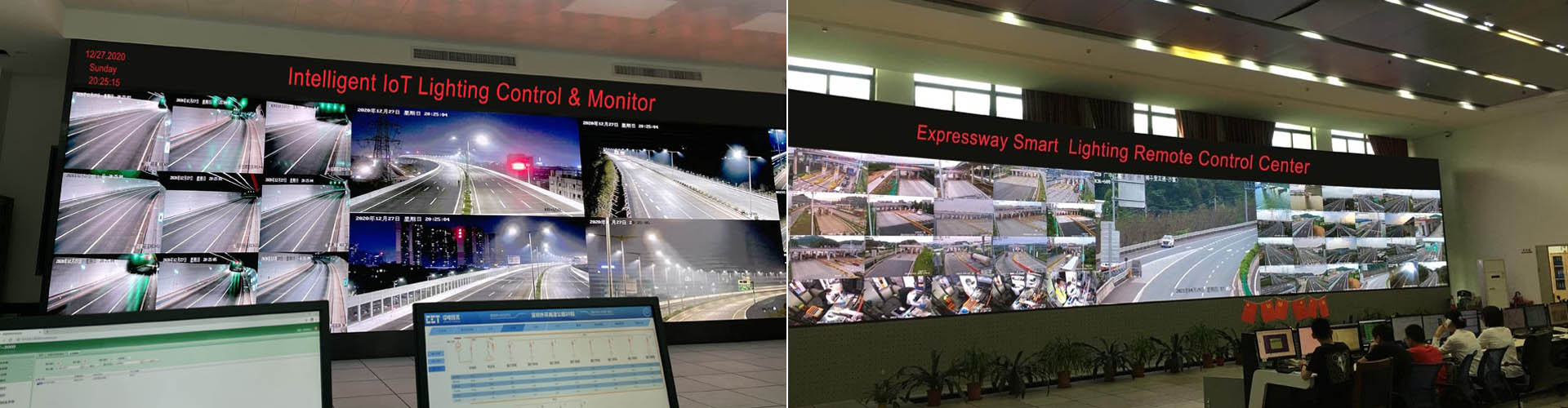
High mast lighting in ports, container terminals, railway stations and airports may not look like tunnel lighting, but the engineering review logic is similar: complex communication, zone control, night safety, local fallback and high-cost maintenance all need clear evidence. The 93KM project video is used as infrastructure-grade proof, not as decoration.
It supports the long-corridor control story: gateway grouping, field communication, dimming scenes, roadway and tunnel lighting discipline, and owner-level infrastructure evidence.
For high mast lighting, this becomes the proof logic for wide yards, long feeder routes, distributed zones and multi-team acceptance.
Some airport hangar and national strategic infrastructure references cannot be disclosed by project name because of confidentiality agreements.
The transferable value is the engineering method: gateway zones, HYBRID PLC & LoRA field communication, offline fallback, FAT/SAT files, configuration backup and owner-held operation evidence.
High mast lighting projects may begin with port lighting, terminal lighting, railway station lighting, airport apron lighting, LED high mast lights, high mast pole lights, yard lighting or smart lighting control. Each application should also be reviewed for communication reliability, local fallback and maintainability after installation.
| Application Requirement | Procurement Question | Engineering Response |
|---|---|---|
| Seaport and harbour high mast lighting | Salt fog, berth safety, long cable routes and night maintenance cost. | Coastal scene + cabinet protection + HYBRID PLC & LoRA + owner evidence. |
| Container terminal and yard high mast lighting | Moving metal obstruction, crane operation and wide-area command reliability. | Dual-channel communication + crane-side response + yard-zone SAT record. |
| Railway station and rail-yard lighting | Passenger safety, track zones, platform scenes and maintenance windows. | Segmented scenes + gateway zones + emergency override + field identity. |
| Airport apron and airside lighting | Glare discipline, security network, service routes and strict acceptance. | Apron-zone control + local fallback + alarm evidence + owner network access. |
| Smart high mast lighting control | Whether remote control reaches the field layer and remains available beyond the dashboard. | PLC + LoRA field layer, CH-800 gateway, FAT/SAT files and lifecycle records. |
High mast projects are often installed in metal-heavy, wide-area and security-managed environments. Ports, terminals, rail yards and airports create moving obstruction, long cable routes, salt fog and strict maintenance windows.
Complex sites should not depend on a single field-control route. PLC supports feeder-based command delivery, while LoRA adds wide-area wireless redundancy. Together they reduce dependence on a single communication route in ports, terminals, railway stations and airports.
Yes. They are useful for backhaul, control-room access, remote monitoring and owner-network integration. The key is that field control should still be protected by PLC + LoRA and local gateway autonomy.
FAT/SAT should verify lighting output, PLC route, LoRA coverage, gateway fallback, alarm evidence, asset identity, maintenance workflow and owner-held records.
STSYSTEMPLC emphasizes system-level continuity across luminaires, controllers, CH-800 Gateway zones, HYBRID PLC & LoRA communication, platform records, maintenance workflow and handover evidence.
For long-term operation, a High Mast Lighting System for Complex Communication Environments should be a recoverable operating system connecting hardware, gateways, cabinets, HYBRID PLC & LoRA communication, alarms, energy records, emergency scenes, maintenance workflow and owner handover evidence.
For project review, prepare pole height, lighting zones, feeder distance, metal-obstruction layout, network restrictions, maintenance workflow and owner acceptance format. The proposal can then be matched to the real field environment instead of a generic fixture list.
Download Project PDFs and Videos Review Interconnected Lighting Architecture
Indirizzo : F4,Bldg A, Hanzhong Industrial Park, No.67, North of Xinsha Ave, Xin Tang, Zeng Cheng, Guang Zhou, China
Tel : +86 20 8278 0427
E-mail : info@stsystemplc.com
E-mail : morrison426@163.com